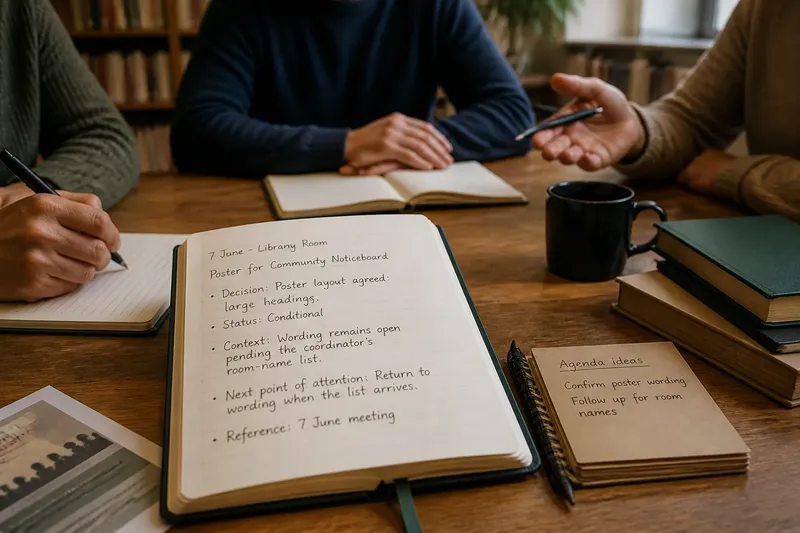
A First Project Check-In That Leaves Room for the Work
A first project check-in can align a team on the work’s purpose, reveal clashing assumptions and choose a useful first task without turning the meeting into status theatre.
Someone opens a laptop, glances at the calendar and asks, “Shall we go round with updates?” At a first project check-in, that familiar opening can make the meeting about individual activity before the team has agreed what the work is for. A better conversation begins with the thing the group is trying to make and leaves room for people to interpret it together.
The first project check-in is not a miniature planning ceremony. It is a chance to establish the project’s working shape: its intended result, the boundaries that matter and the first piece of work the team can tackle. The discussion should help people see how their different expertise fits together, not just give everyone a turn to speak.
Give the conversation a concrete object
Bring something the group can react to: a draft brief, a request from a colleague, a sketch, a set of user comments or an early version of the thing being made. The object need not be polished. Its purpose is to shift discussion from vague intentions towards choices the team can inspect.
Choose material that reflects the project’s actual starting point. A draft brief may show that the audience is unclear; a prototype may reveal that the team is already debating details before agreeing on the problem. Avoid preparing an elaborate deck that turns the meeting into a presentation by one person.
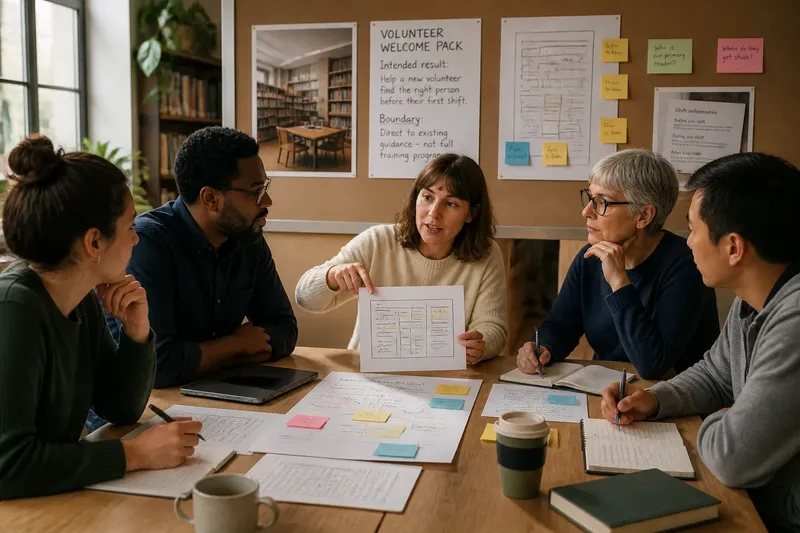
Say you are coordinating a neighbourhood library’s new volunteer welcome pack. You bring the request that prompted the work and a rough page listing where volunteers currently find shift information. The group can point to what is missing and discuss the intended reader, rather than beginning with a recital of tasks that have not yet been agreed.
Make the project’s boundaries discussable
Ask what the work is meant to change for someone who will use it. A result such as “help a new volunteer find the right person before their first shift” gives the team a point to examine. “Improve onboarding” describes an aspiration, but leaves the audience and the useful outcome unstated.
Then ask what the project is not setting out to do. A welcome pack might direct volunteers to existing guidance without rewriting the organisation’s full training programme. Naming that boundary helps the group recognise later requests that belong elsewhere, while leaving room to revise the scope if the original need proves mistaken.
Listen for different readings rather than smoothing them over. If one colleague imagines a printable sheet and another expects a searchable online resource, the difference affects format, access and effort. Put both interpretations into plain language and ask what would help the group choose between them.
Turn different expertise into a useful first move
Once the intended result is clearer, ask what each person can see that others may miss. A frontline colleague may know which instructions confuse new volunteers; a designer may notice that the proposed format will be difficult to scan; an administrator may know where current information is maintained. These are contributions to a shared judgement, not separate reports of activity.
Look for a first task that brings those perspectives together and produces something the team can discuss. That may mean reviewing an existing document, speaking with someone who uses the service, or sketching a rough version of the resource. Choose the task for the question it will help answer, not because it fills an empty slot in a schedule.
In the library example, suppose the group learns that volunteers often ask where to report a late arrival. A useful first move could be to check the existing shift instructions and draft a short passage that directs readers to the right contact. The observable result is a concrete piece of wording the group can review for accuracy and clarity; it is not a claim that the wider pack is finished.
Use disagreement to reveal what the team needs to decide
Not every difference of opinion needs a vote. Some disagreements point to missing information: the intended reader may not have been consulted, or the team may not know which existing guidance is authoritative. Others are genuine choices between workable options, such as a printed sheet or a page on the organisation’s website.
Ask what kind of disagreement is in front of you. If the group lacks a fact, name the source that could clarify it. If there are several viable options, compare them against the agreed purpose and constraints. If the decision belongs to someone outside the meeting, identify the person or group whose judgement is needed before treating an option as settled.
This approach keeps dissent attached to the work instead of making it a test of loyalty. A colleague who questions the proposed format may be protecting access for people who do not regularly use the organisation’s website.
What should the first project check-in settle?
Should everyone give an update?
Only invite updates that change the group’s understanding of the work, its dependencies or its choices. If a detail does not affect a shared decision, it can be handled elsewhere rather than taking time from the project’s purpose.
What if the project brief is vague?
Use the request, draft or other starting material to identify what is unclear: the audience, the intended result, the boundaries or the decision-maker. The group can agree on a useful question to resolve before committing to a detailed plan.
How can a quieter colleague contribute?
Ask for reactions to a specific part of the work rather than a general invitation to speak. Leave a pause, and offer a way to comment on the draft after the meeting if someone needs time to form a considered response.
When is a decision ready to make?
A decision is ready when the people with relevant authority have enough information to compare the options against the project’s purpose and constraints. If a crucial fact or perspective is missing, name it before the group commits.
Leave with a shared account of the work
Before the conversation ends, ask someone who has not been leading the discussion to describe what they understand the project to be making and what the team is doing next. This is a quick way to hear whether the group has reached the same interpretation, without asking people to repeat a formal summary.
Then state the project’s purpose, its current boundary and the first piece of work in language the team can recognise. The first project check-in has done its job when that account gives people a sound basis for acting while making clear which choices still need discussion.
Keep the practical test modest: can a teammate explain what the work is for and why the group chose its first move? If not, revisit the purpose before adding more tasks.