How Teams Kept Decisions Alive Before Meeting Agendas
Learn how teams used a shared record before the meeting agenda, so decisions survived between gatherings and members could prepare with the same context.
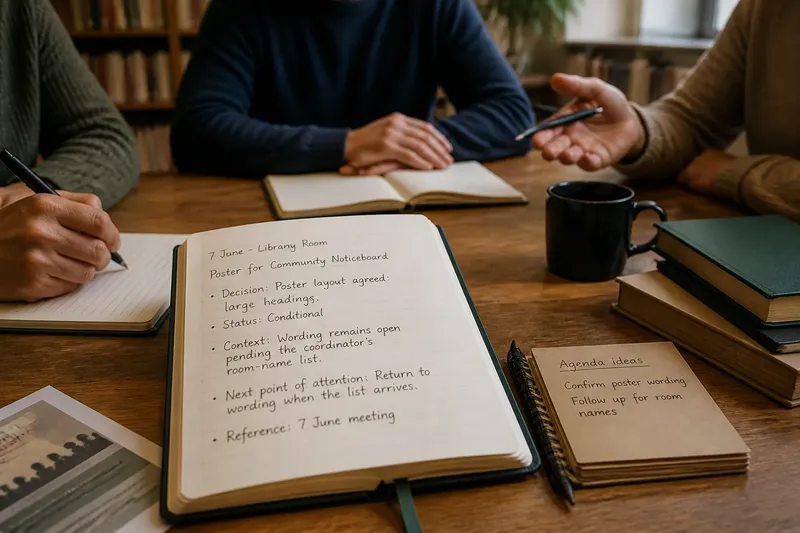
Before a meeting agenda is written, a team often needs to remember what happened last time: the choice that shaped the work, the question still unsettled, and the point at which discussion should resume. A shared record gives those details a place to wait. It is not another name for minutes; it is the bridge between one gathering and the next.
A shared record gave the next meeting its starting point
In a group without a reliable record, the next conversation can begin with competing recollections. Someone remembers a proposal as approved; another remembers it as conditional. The agenda then has to spend time rebuilding the previous discussion before members can decide what to do now.
A shared record changes that sequence. The group first preserves the outcome and its status, then uses that account to shape the agenda. A decision that needs no further attention can stay in the record without taking up meeting time. An unresolved issue can become an agenda item, accompanied by the context needed to continue it.
The record need not be formal minutes. It can be a dated page in a notebook, a section of a shared document, or a set of cards on a board. Its purpose is continuity: to help the next meeting begin where the work actually stands.
Teams used records to carry agreements between gatherings
Before calendars, shared drives and project boards, groups still needed ways to preserve agreements. A ledger, register or notebook could hold a decision and the names of those expected to act on it. The particular medium mattered less than a shared understanding of where the record was kept and how entries were added or corrected.
This practice also explains why a record and an agenda are different tools. The record looks back just far enough to preserve what the group established. The agenda looks forward, selecting which matters need attention in the next conversation. When the record is clear, an agenda can be selective rather than a second attempt to reconstruct the past.
For present-day teams, the same distinction can be kept without imitating an old ledger. A shared document may hold decisions and brief context, while an agenda draws only on the entries that call for discussion. Keep the historical trace and the next meeting’s plan connected, but do not make them the same document by default.
Entries worked best when they showed status and context
A useful entry did not need to reproduce every exchange. It needed to tell a later reader what the group concluded, whether the conclusion was firm, and what information would help interpret it. When the decision depended on a condition, that condition belonged beside it.
For example, a team might record that it had chosen a draft layout, but only for review with a partner; the choice would be reconsidered if the partner could not read the labels. That note preserves both the present decision and its boundary. At the next meeting, the group can check the condition instead of debating the choice from memory.
Useful entries often include:
- Decision: what the group chose, stated plainly.
- Status: whether the matter is settled, proposed, conditional or open.
- Context: the reason or constraint a future reader needs to understand the choice.
- Next point of attention: what should prompt the group to return to it.
- Date or meeting reference: enough information to locate the discussion if more detail is needed.
Write for someone who was not present, but resist turning the record into a transcript. A short, intelligible account is easier to use than a long passage where the decision is buried.
A simple worked example shows how the record shapes an agenda
Imagine a volunteer group has a paper notebook and meets in a library room. At one gathering, members discuss a poster for a community noticeboard. They agree that the design should use large headings, but leave the wording open until the venue coordinator confirms which room names are current.
One member writes: “Poster layout agreed: large headings. Wording remains open pending the coordinator’s room-name list. Return to wording when the list arrives.” Before the next gathering, the coordinator has not replied. The group checks the entry and places “Confirm poster wording and decide whether to follow up for room names” on its agenda. The result is a focused discussion: members can address the delay and choose a next action without reopening the already settled layout.
If the list had arrived, the record would still be useful, but the agenda could instead ask members to approve the wording. The same note supports either decision because it distinguishes what was settled from what was waiting.
Choose a format people can return to
A paper notebook suits a group that gathers in one place and can store the book where members expect to find it. A shared document is more convenient when people contribute from different locations or need to prepare asynchronously. A wall chart makes visible changes easy to notice, while a project board can show how pieces of work relate. Each format has limits: paper can be hard to consult remotely, and a board may not leave enough room for the reasoning behind a choice.
Choose according to how the group will retrieve information, not according to the number of features a tool offers. If the team uses a shared document, give it a recognisable title and place it alongside the calendar or agenda. If it uses a notebook, agree who takes it to each gathering and where it is stored between meetings.
Keep one agreed location as the current record. If supporting notes live elsewhere, link or point to them rather than copying entries into several places that may drift apart.
Small routines kept the record credible
A record becomes useful through ordinary habits, not elaborate administration. At the end of a discussion, the person who writes the entry can read it back aloud so members can correct the wording before they leave. At the start of the next gathering, someone can check which entries belong on the agenda.
When circumstances change, update the entry visibly. Mark an old choice as superseded rather than quietly erasing it; distinguish an open question from a decision; and correct an inaccurate note as soon as someone spots it. These habits let the record show not only what the group thought before, but how its understanding changed.
For confidential matters, follow the organisation’s rules about access and retention. A routine shared record should not become a place for personal details that the group does not need to carry into its next meeting.
How should a shared record guide the next agenda?
Should the record contain the whole discussion?
No. Keep the decision, its status and the context needed to understand it; refer to fuller notes only when those details matter later. A concise record helps the agenda focus on what genuinely needs another conversation.
What belongs on the agenda rather than in the record?
Put a matter on the agenda when the group needs to discuss, decide or review it together. Leave completed decisions in the record for reference, unless a changed condition gives the group a reason to revisit them.
Who should write the entry?
The group can rotate the task or ask the person closest to the discussion to draft the note. Whoever writes it should invite corrections, because the record represents the group’s understanding rather than one person’s interpretation.
When should a recorded decision return to discussion?
Bring it back when its stated condition changes, new information makes its reasoning doubtful, or members can no longer act on it as written. Note what changed so the next entry does not appear to contradict the earlier one without explanation.
Use the record to make meetings smaller and clearer
A shared record does not remove disagreement or make every meeting brief. It does make it easier to distinguish remembering from deciding. Members can arrive with the same account of what was settled, identify what remains open, and spend their conversation on the matters that need their attention.
When setting up a shared record for team meetings, begin with the questions members repeatedly ask after a gathering: What did we decide? What is still waiting? What belongs on the next agenda? A format that answers those questions plainly is more useful than one that records every word.