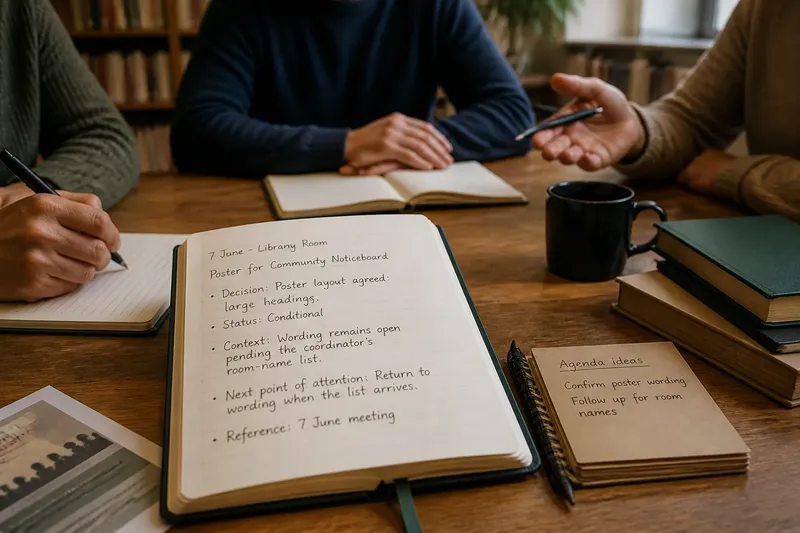
The Handoff: What Helps Work Move Between Teammates
A clear handoff helps the next teammate start from the task’s current state, understand what remains and avoid piecing its history together from scattered notes.

A designer opens a shared folder to finish a colleague’s draft and finds three files called “final”, a comment thread, and no clear indication of which version is current. A useful handoff prevents that familiar pause. It names the task’s present state, records what is done and makes the next action visible without asking the next person to reconstruct the whole story.
That is the purpose of a handoff between teammates: not to retell every conversation, but to transfer enough working knowledge for someone else to take responsibility. When it goes wrong, the cause is often not carelessness. People may be working across different tools, making assumptions about what is obvious, or handing over a task before its boundaries are clear.
The handoff describes activity but not the current state
A note such as “I’ve been working on the supplier comparison” tells the next person what occupied someone’s time, but not what they can use. They still need to know whether the comparison is a rough draft, a reviewed recommendation or a set of unverified notes.
This gap appears when updates are written as a record of effort rather than a description of the work as it stands. The sender knows what changed during the day; the receiver sees only the task name and a vague status.
Try writing the current state as a plain, observable description. Say what exists now, where it lives and what condition it is in. “The comparison table is in the shared procurement folder; three options are entered, and the delivery terms for the last one are still unconfirmed” gives the next teammate something they can inspect.
Then put the next action on its own line. A status describes the present; a next action points towards the next piece of work. Keeping them separate helps prevent a tentative task from looking finished.
The record lists decisions without their boundaries
A handoff may say “we chose the compact version” while omitting what that choice depended on. Perhaps it was preferred only for the first release, or only if a particular material remained available. Without the boundary, a provisional choice can be mistaken for a permanent one.
This usually happens when a conversation produces a useful direction before every condition has been settled. The person handing over remembers the qualification because they were present. The next person encounters a short note that appears more definite than the decision really was.
Try recording a decision alongside its scope and any unresolved condition. For instance: “Use the compact layout for the draft; confirm the label space before preparing production files.” If no decision has been made, say so directly and name what information is still needed.
That small distinction lets the next teammate move forward where the work is settled without treating open questions as instructions.
Completed work is mixed with work still in progress
When finished items and unfinished items sit in one dense paragraph, readers can mistake a plan for a completed action. “Images selected, copy checked, legal review next” may be clear to its author, but the sequence can blur when skimmed between other tasks.
The cause is often a handoff written in one sitting from memory. The writer knows which verbs refer to past work and which describe intentions, but the note does not make that distinction easy to scan.
Try grouping the information under short labels such as “Done”, “Open” and “Next”. Use concrete verbs: “selected”, “checked”, “awaiting” and “send”. Avoid calling work complete if a related check remains open; instead, state exactly which part is done and which part is not.
Imagine you are handing over an event page. The text is approved, the venue image is in the project folder, and the accessible description has not been drafted. A note that separates these facts gives the next teammate a clean starting point: prepare the description, then check it against the chosen image.
Files and messages leave the receiver searching
“See the thread” is not a helpful destination if several channels contain similar conversations. “Use the latest file” is no better when filenames do not distinguish a review copy from an approved one. The sender may have a reliable mental map; the person receiving the task does not.
This problem grows when work is spread across email, chat, shared drives and task boards. Each tool can hold part of the story, so a handoff that names only the project may send its reader on a search through unrelated material.
Try pointing to the smallest useful set of records. Name the file or task, identify the relevant location, and link to the particular comment or decision if the tool allows it. If there are several drafts, say which one is active and why the others remain.
For example, “Continue in the ‘Landing page’ task; the approved copy is attached there, and the open question about the image is in the design comment dated today” gives a route without copying the whole discussion into a new message.
Questions readers ask about a teammate handoff?
What should a handoff include?
Include the task’s current state, what has been completed, what remains, the next action and where the working material can be found. Add a decision or unresolved question when it changes what the next person should do.
How detailed should a handoff be?
Give enough detail for the receiver to begin and recognise the limits of the task, but leave out background that does not affect the next action. If a detail could change the work, keep it; if it only repeats the history, point to the relevant record instead.
What if the work is not ready to pass on?
State what is incomplete and what is needed before the receiver can proceed. A clear handoff can transfer a blocked task too, provided it identifies the obstacle, the person or information awaited, and any useful work that can continue meanwhile.
Should the handoff happen in a message or a meeting?
Use the team’s normal task record or shared workspace for information the next person will need to find again. A brief conversation can clarify ambiguity, but record the resulting state and next action where the work itself is tracked.
The next action has no owner or boundary
“Follow up with the venue” leaves room for two people to assume the other will do it, or for each to contact the same person. An action becomes easier to take up when the handoff names who owns it and what completion means.
This omission often appears when responsibility is changing hands informally. The sender may think that passing along the task transfers ownership; the receiver may think they are being asked only to assist. The work then sits between those interpretations.
Try stating the next action with an owner and a clear boundary: “Mina will ask the venue to confirm access details; the task can move to scheduling once that reply is recorded.” If ownership is still being agreed, say that rather than assigning it by implication.
Keep the boundary modest. A handoff need not dictate every later choice; it should make the immediate responsibility and the point of return clear.
Too much background hides the useful information
Some handoffs become long because the sender tries to preserve every detail, concern and conversation. The receiver must then work out which parts affect the next move. A lengthy note can still omit the one fact that matters: what is ready now.
This usually reflects a reasonable worry that context will be lost. The remedy is not to strip away context indiscriminately, but to separate the working summary from the history. Put the current state and next action first; link to earlier discussion for anyone who needs to trace how the task arrived there.
Try a short handoff with these concrete elements:
- Task: name the piece of work being passed on.
- Current state: say what exists now and where it is.
- Done: identify completed work without implying unfinished checks are complete.
- Open: state remaining questions, dependencies or blockers.
- Next action: name the immediate move and its owner.
- Source: link to the relevant file, task or decision record.
Use only the items that fit the task, and keep each one specific. A small handoff that answers the receiver’s immediate questions is more useful than a complete transcript.
A handoff should leave room for the receiver to clarify
Even a careful note can meet an unfamiliar process or an unexpected detail. Treating the handoff as a sealed package makes it harder for the receiver to flag a missing assumption before acting. Treating it as an invitation to ask one focused question keeps responsibility clear while allowing the work to continue.
When you send a teammate handoff, leave a route for clarification and say what can proceed without a reply. “The draft is ready for layout; please ask me about the image licence before publishing” separates an actionable next step from a decision that still needs context.
A useful handoff does not carry every part of the past into the next person’s hands. It gives them a truthful picture of the present, a visible boundary around what remains, and a first action they can take. For any teammate handoff, check that the receiver can locate the work and tell what to do next without guessing.